

A real estate virtual assistant could be the single most impactful hire you make this year. If you are an agent who feels like you are working harder than ever but closing fewer deals, the problem probably is not your hustle. It is where your hustle is going.
Think about the last full week you worked. How many of those hours were spent in front of buyers and sellers, negotiating, building relationships, and closing deals? Now honestly count the hours that went to updating your CRM, chasing documents, uploading listings, scheduling showings, and answering emails that could have been handled by someone else.
For most agents, that second list is longer than the first. And that is the real reason top-producing agents are quietly bringing in virtual assistants while everyone else is wondering how they do it.
The Admin Load Is Killing Your Commission
Real estate is a relationship business, but it has been hijacked by administration.
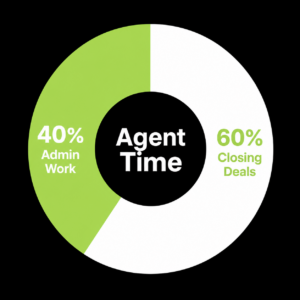
Research shows that agents spend anywhere from 30 to 40 percent of their working hours on tasks that do not require their license, their network, or their expertise. That is 15 to 20 hours every single week on emails, paperwork, listing coordination, and CRM updates. Hours that should be going toward showing homes, nurturing leads, and closing deals.
And then there is the lead response problem. The average agent takes 917 minutes to respond to a new inbound lead. That is over 15 hours. By that time, your lead has already hired someone else. Studies consistently show that 78 percent of buyers and sellers work with the first agent who responds to them. If you are buried in admin when a new lead comes in, you are handing that deal to a competitor.
A real estate virtual assistant does not just save you time. It saves you deals.
What a Real Estate Virtual Assistant Actually Does
This is where people get surprised. A real estate VA is not someone who answers the occasional email or books a meeting once a week. A well-briefed virtual assistant can run entire segments of your operation independently, freeing you to focus on the work only you can do.
Here is what a great real estate virtual assistant handles on a regular basis:
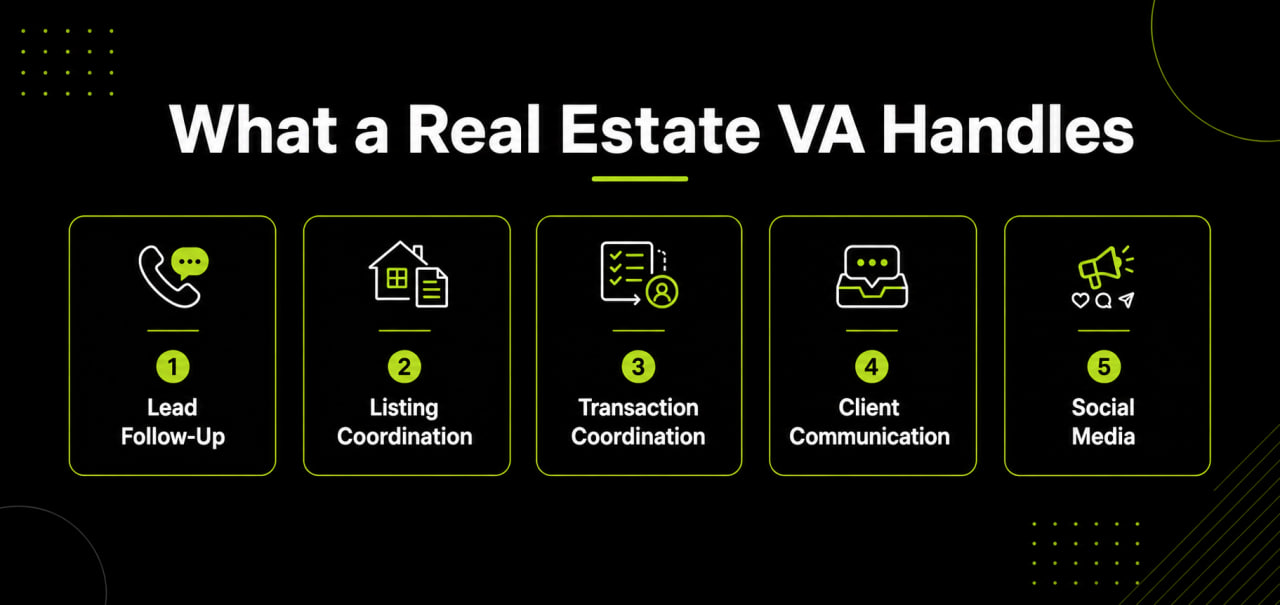
Lead Follow-Up and CRM Management
Your VA monitors your lead sources, sends first responses within minutes, updates contact records, and runs your follow-up sequences so no lead goes cold. This alone is worth the investment. Research from AgentZap’s 2026 data shows that 80 percent of sales require five or more follow-ups, yet 94 percent of agents quit before reaching the fifth contact. A real estate virtual assistant closes that gap every single time.
Listing Coordination
Writing and uploading property descriptions, syncing listings to Zillow, Realtor.com, and other portals, preparing showing schedules, and coordinating feedback after viewings. Your VA keeps the listing engine running while you focus on your next opportunity.
Transaction Coordination
From accepted offer to closing day, a real estate transaction has 40 to 60 touchpoints. Your VA tracks deadlines, chases documents, follows up with lenders and title companies, and makes sure nothing falls through the cracks. The deal closes on time because someone is watching every moving part.
Client Communication
Weekly update emails to buyers and sellers, inbox management, appointment confirmations, and post-closing review requests. Your clients feel looked after without you manually managing every touchpoint.
Social Media and Marketing
Scheduling and publishing posts across Instagram, Facebook, and LinkedIn, creating listing graphics, sending your newsletter, and managing your Google Business profile. Your brand stays active and consistent even when you are in back-to-back showings all day.
The Numbers That Make the Case
Let us talk ROI because the math here is genuinely compelling.
Agents with proper VA support managing their operational workload commonly move from closing 10 to 15 transactions per year to closing 20 to 30. That is not a marginal improvement. That is a business transformation.
The lead response numbers are even more sobering. Each missed lead due to slow response costs an agent approximately $7,500 in potential commission. Agents losing 27 to 40 leads per year to slow follow-up are leaving between $200,000 and $300,000 on the table annually. A real estate virtual assistant who manages your lead response alone pays for itself many times over.
And here is a stat worth printing and taping to your monitor: 62 percent of real estate agents say time management is their single biggest professional challenge. Not market conditions. Not inventory. Time. That is a solvable problem.
The Leads Sitting in Your CRM Right Now
Here is a scenario most agents know intimately. You get a burst of leads from a campaign, a referral, or an open house. Life gets busy. You tell yourself you will follow up properly tomorrow. Tomorrow becomes next week. The lead goes cold. You write it off.
This is not a motivation problem. It is a systems problem. And it is one that a real estate virtual assistant solves completely.
Your VA works your CRM on a defined schedule. First contact, second contact, 30-day check-ins, and quarterly touchpoints for long-cycle prospects. The follow-up that most agents do inconsistently becomes something that happens every single time, on time, without you having to think about it. Deals you would have lost start converting.
The highest-performing agents delegate lead nurturing as one of the very first tasks when bringing on a VA, and the results in pipeline conversion are consistently among the most measurable wins they report.
What Only You Can Do
Here is the framework that changes how high-performing agents think about their day.
There are tasks that require your license, your judgment, your personal relationships, and your expertise. Negotiating a deal. Walking a first-time buyer through their options. Earning a listing from a homeowner who interviewed three other agents. That is your zone. That is where your commission gets earned.
Then there is everything else. Calendar management, document prep, portal updates, email triaging, social scheduling, follow-up sequences. Those tasks do not require you. They require someone reliable, organised, and trained. That is exactly what a good real estate virtual assistant is.
The agents closing the most deals in 2026 are not the ones working the most hours. They are the ones who figured out what only they can do, and handed everything else to someone they trust.
How to Get Started With a Real Estate Virtual Assistant
If you have never worked with a VA before, the best move is to start with your most painful area and expand from there. Most agents begin with lead follow-up or inbox management and add responsibilities as the relationship builds.
By the end of the first month, most agents with a good real estate virtual assistant wonder how they ever managed without one. Not because the VA is doing something magical, but because having someone else handle the operational layer means you finally get to do the job you actually built your career to do.
At taskbaba.com, we match real estate professionals with trained virtual assistants who understand your workflows, your tools, and your industry. Whether you need lead follow-up support, listing coordination, transaction management, or full operational coverage, we have a VA ready to make an impact from week one.
Book a free scoping call and let us map out exactly what your real estate virtual assistant can own so you can get back to closing deals.
Or browse our VA services and find the right level of support for where you are right now.
Your next deal is probably already in your pipeline. It just needs someone to follow up on it.